Agent harness design for fast, expressive feedback
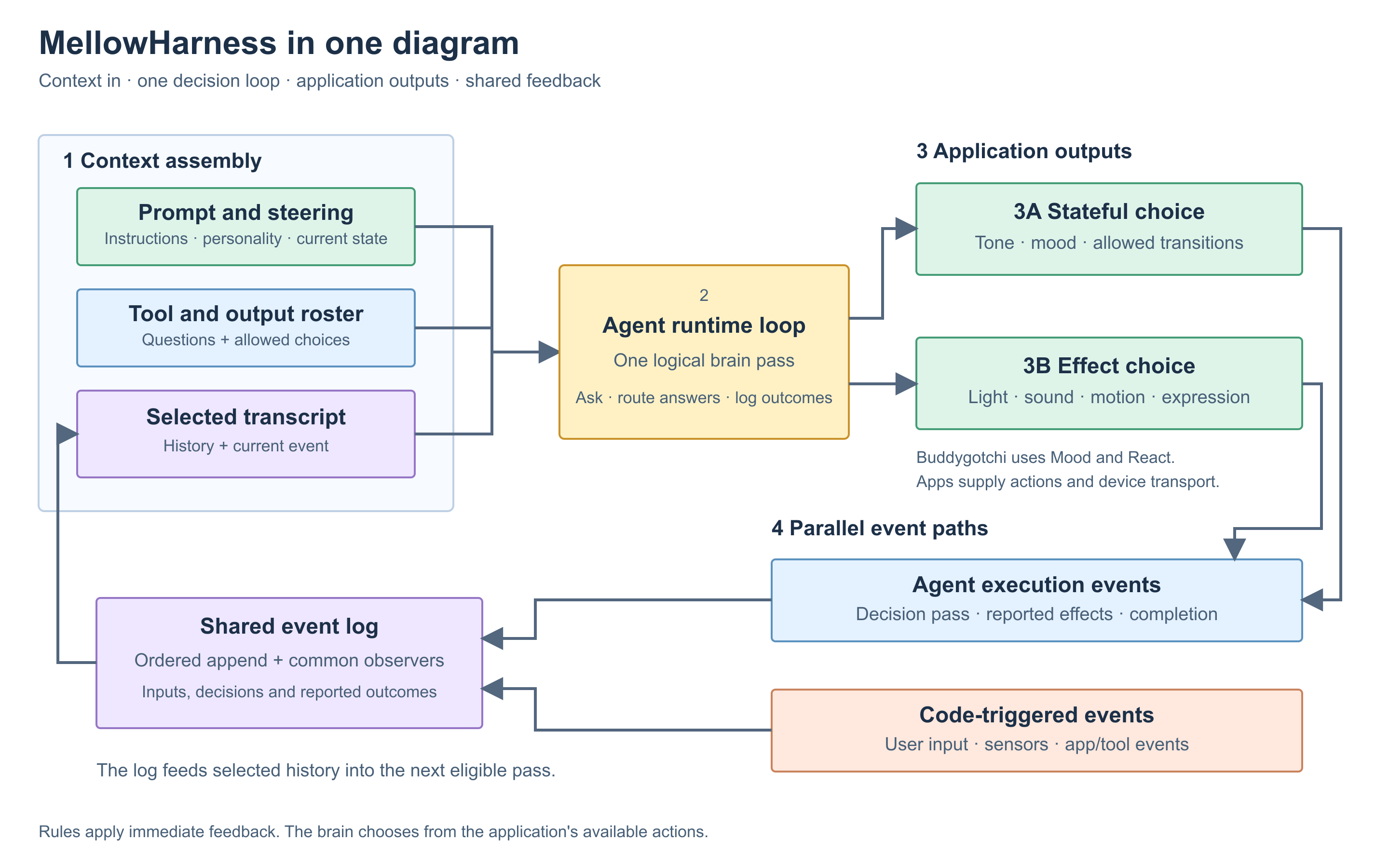
How MellowHarness combines a System One decision loop, bounded action choices, immediate rules and a shared JSONL event log for AI hardware and applications.
Guide added 10 October 2026

The Lab notebook
Agent harness design, System One Models and expressive companions. Source-backed guides from the decision loop to an ESP32 build.
Start with the architecture
How MellowHarness combines a System One decision loop, bounded action choices, immediate rules and a shared JSONL event log for AI hardware and applications.
Read the harness guide →
How MellowHarness combines a System One decision loop, bounded action choices, immediate rules and a shared JSONL event log for AI hardware and applications.
Guide added 10 October 2026

A source-backed guide to Jev, OpenAI Decisions API and the open-source Laya project. Typed action choices, integration status and evaluation boundaries.
Guide added 10 October 2026
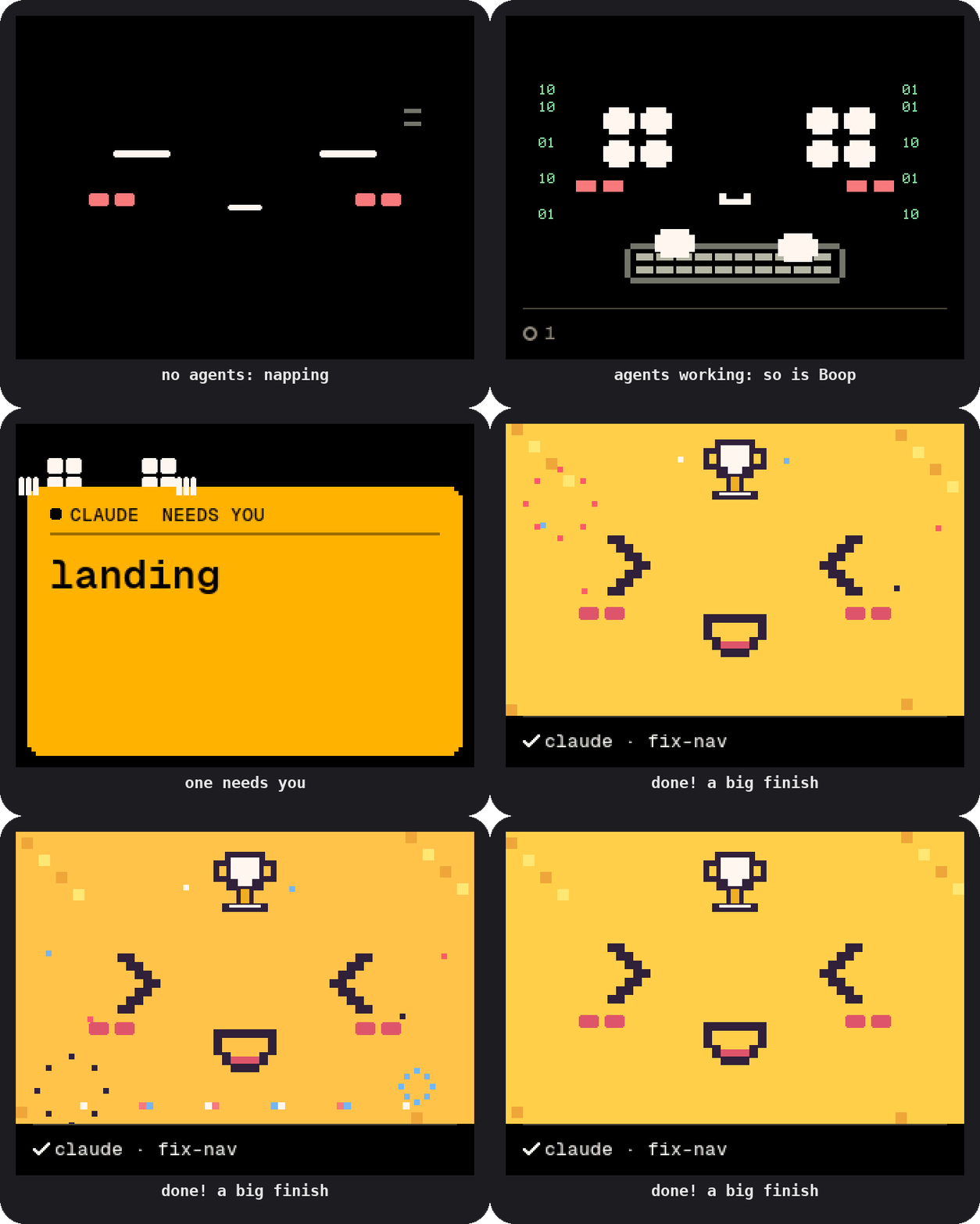
Connect coding-agent hooks to Buddygotchi’s state, mood and character. MellowHarness architecture, public build requirements and scripted-demo boundaries.
Guide added 10 October 2026

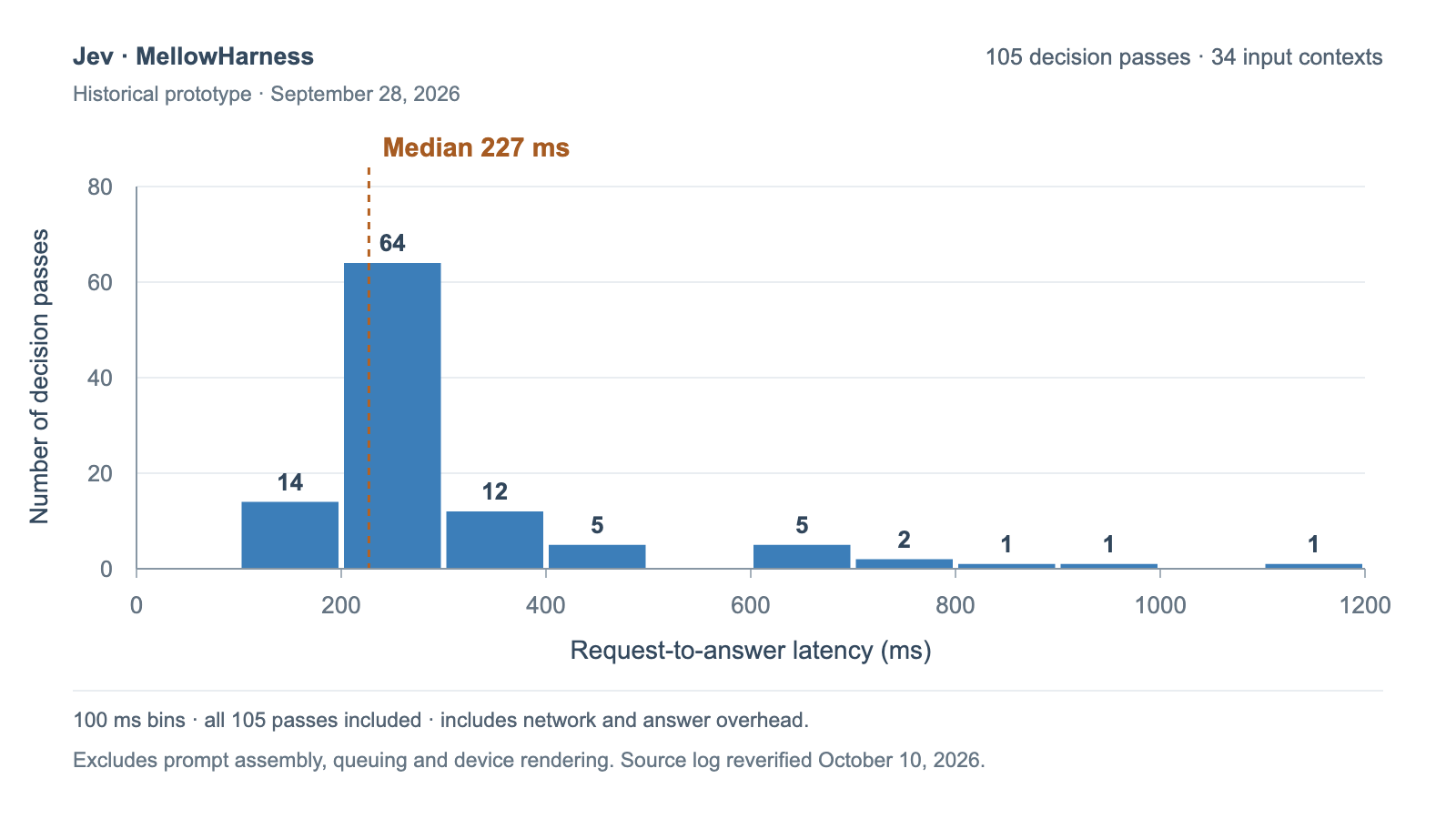
An audited historical Jev sample: 227 ms median across 105 decision passes. Full distribution, sanitized data and limits of the measurement.
Guide added 10 October 2026

The decision loop, two event paths and the personality, mood and operational-state layers in Buddygotchi.
Originally shared 7 October 2026

Run Beacon, send events and inspect how rules and model choices meet in the log.
Guide added 9 October 2026
Follow the public Pixel build: coding-agent events, connected moods, animation packs, a CYD display and the first device checks.
Guide added 9 October 2026

Understand the architecture, choose a supported display board and follow the Buddygotchi setup.
Guide added 9 October 2026
The exact supported board, USB data cable, host requirements and optional speaker or storage. Includes a board comparison.
Guide added 9 October 2026
Exact board models, pin assignments, build targets and troubleshooting for the supported Buddygotchi displays.
Immediate application rules, bounded model choices and one shared event log. Start with the scripted brain, then connect Jev or another brain.
A Mac host and ESP32 display turn coding-agent events into work, attention and expressive reactions. The repository currently calls the companion Boop.
One event stream for Claude Code and Codex hooks. Track working, idle and needs-you sessions in your own application.
The Lab’s public organization profile and shared community files.
A compact application example to read alongside the quickstart. Adapt its inputs and outputs to your own project.
The event log, prompt assembly, inputs, rules, outputs and contract for your own brain adapter.
How authored steering, a connected mood graph and state-based faces form a character. The public Pixel pack is the starting example.
The state, action and event messages between the host and the gadget. LinkKit currently lives inside the Buddygotchi repository.
Our published Substack sharings are collected here alongside original Lab guides. Follow Substack for updates, or the guide RSS feed for new walkthroughs.
Publication archive checked 9 October 2026 · 1 published Substack article.
The current runtime runs on a host. Buddygotchi uses a Mac app with an ESP32 display connected over Bluetooth or USB. The ESP32 guide explains the split.
Start with the exact CYD board in the parts list, a USB data cable and the public Pixel pack. Check character compatibility before choosing a different board.
Yes. MellowHarness includes ScriptedBrain. The quickstart uses it to exercise rules, decisions and the shared log without hosted inference.
Start with the contribution guide, or follow Lab updates on Substack. New guides will be listed here as we document the projects.